Why Babies Sometimes Refuse Food
In the first year, breast milk or iron‑fortified formula supplies the bulk of a baby’s nutrition, with solids serving only as complementary foods. Introducing solids before a child shows readiness—sitting up with minimal support, good head and neck control, loss of the tongue‑thrust reflex, and genuine interest in what others are eating—can lead to frustration and refusal. Even when a baby is developmentally prepared, a chaotic or overstimulating mealtime can overwhelm tiny sensory systems, making the child turn away from food. Creating a calm, distraction‑free environment, offering small portions, and respecting hunger and fullness cues support a positive feeding experience. If a baby consistently refuses solids after several attempts, shows gagging, vomiting, poor weight gain, or other red‑flag symptoms, parents should seek prompt pediatric evaluation. Early professional guidance can prevent feeding disorders and ensure healthy growth through childhood and adolescence.
Feeding Foundations: Milk, Readiness, and Responsibility
Key Points
| Aspect | Recommendation |
|---|---|
| Primary nutrition (0‑12 mo) | Breast‑milk OR iron‑fortified formula exclusively for the first year. |
| Developmental readiness for solids | • Sits upright with minimal support <br>• Good head‑neck control <br>• Loss of tongue‑thrust reflex <br>• Shows interest in food (usually ~6 mo). |
| Division of responsibility (AAP) | Caregiver decides what, when, how; infant decides how much. |
| Typical milk volume | 24‑32 oz (≈710‑945 ml) per day, on demand, until 12 mo. |
| Red‑flag signs to monitor | Persistent refusal, poor weight gain, dehydration, vomiting, or illness. |
When in doubt, contact your pediatrician.
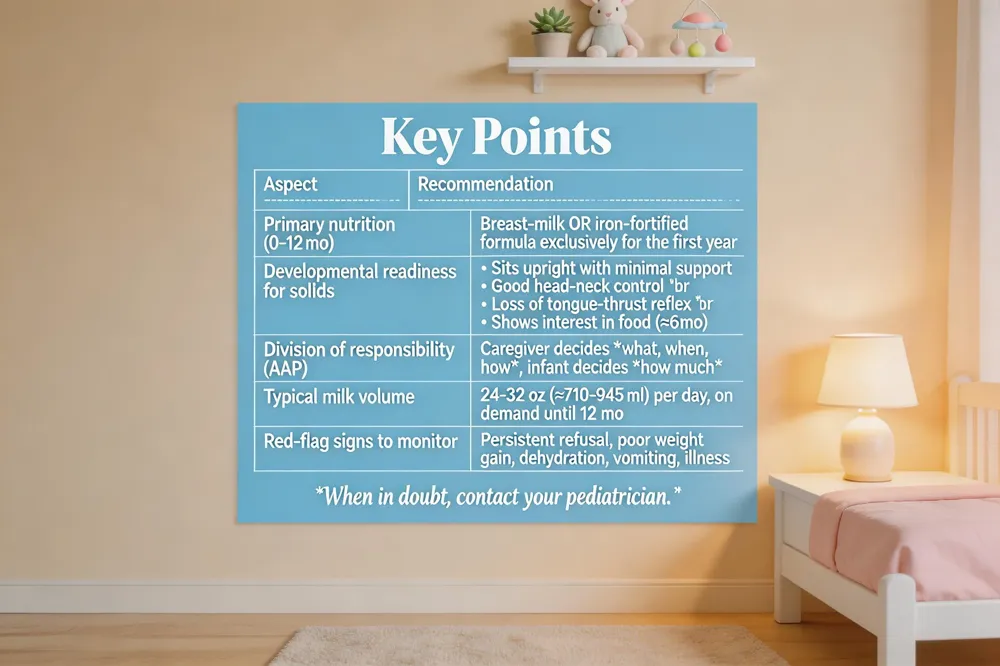 U.S. pediatric guidelines agree that breast‑milk or formula should remain the baby source of nutrition through the first 12 months. Solids are introduced only when the baby shows developmental readiness—sitting up with minimal support, good head‑neck control, loss of the tongue‑thrust reflex, and interest in food—usually around six months. The American Academy of Pediatrics’ "division of responsibility" model places control of what, when, and how food is offered in the caregiver’s hands while the infant decides how much to eat, fostering a calm, responsive feeding environment.
My baby is not eating anything. What should I do? Check health, hydration, and fatigue; offer breast‑milk or formula, a brief nap, then try a quiet, distraction‑free feeding. Ensure the baby is developmentally ready for solids and start with smooth purees, progressing to thicker textures. If discomfort, illness, or persistent refusal occurs, call the pediatrician promptly.
Why is my baby not eating food suddenly? Overtiredness, distractions, illness (cold, reflux, teething), or a mismatch of texture can trigger a brief loss of appetite. Most issues resolve, but seek medical advice if refusal continues, weight gain stalls, or dehydration signs appear.
What age is considered a newborn? A newborn (neonate) is 0‑28 days old; clinicians often extend this period to the first two to three months for practical reasons.
Causes of poor feeding in newborn. Illness, reflux, anatomical anomalies (cleft palate, tongue‑tie), neuromuscular weakness, premature birth, or low birth weight can all impair feeding.
Signs of good feeding in newborn. 8‑12 feeds per day, rhythmic sucking, steady weight gain (≈5‑8 oz/week), frequent wet diapers, and alert, content behavior indicate adequate intake.
Introducing Solids: Nutrition from 6‑12 Months
Typical 6‑12 mo Feeding Schedule
| Time of Day | Milk (oz) | Solid Meal (portion) | Example Foods |
|---|---|---|---|
| Morning | 6‑8 | 1‑2 Tbsp puree | Iron‑fortified cereal, pureed fruit |
| Mid‑morning | 4‑6 | — | — |
| Lunch | 6‑8 | 2‑3 Tbsp puree | Veggie (sweet potato, peas) + protein (lentils, meat) |
| Afternoon | 4‑6 | — | — |
| Dinner | 6‑8 | 2‑3 Tbsp puree | Fruit (banana, apple) + cereal |
| Evening | 4‑6 | — | — |
| Throughout | 4‑8 oz water in a cup | — | Hydration (avoid cow’s milk until 12 mo). |
Nutrition Highlights
- Iron‑rich foods: fortified cereals, pureed meats, eggs, lentils, peas, beans.
- Variety of colors & textures; progress from smooth to thicker purees, then finger foods around 9 mo.
- Avoid: honey, cow’s milk, plant‑based milks, added sugars.
Portion sizes increase as the infant shows interest and can handle thicker textures.
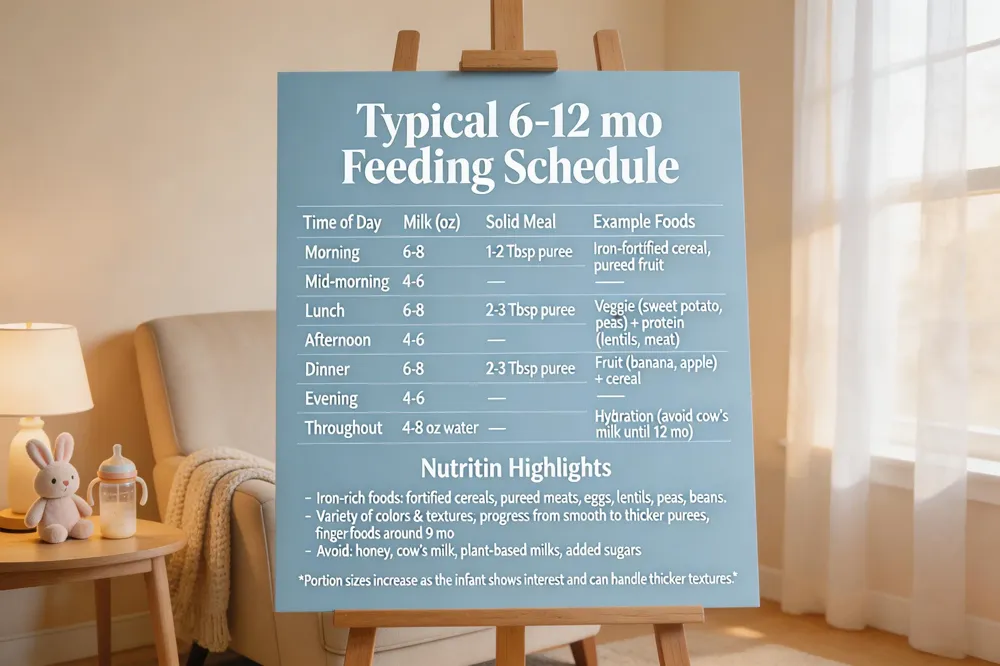 Nutrition for babies 6‑12 months
During the second half‑year breast milk or iron‑fortified formula still supplies about half of daily calories. Offer 1‑2 teaspoons of pureed foods at first, gradually increasing to several tablespoons per meal, aiming for 5‑6 small meals or snacks daily. Include iron‑rich cereals, pureed meats, eggs, lentils, peas, beans, and a variety of vegetables, fruits, whole‑grain breads or crackers. Plain water (4‑8 oz) in a cup helps hydration; avoid cow’s milk, plant‑based milks, and honey until 12 months.
Baby first foods 4‑6 months
Readiness signs appear at 4‑6 months: sitting with support, good head‑neck control, and interest in eating. Start with thin iron‑fortified single‑grain cereals mixed with breast milk or formula, then pureed avocado, peas, sweet potato, banana or apple. Introduce one new food at a time, waiting 3‑5 days for reactions. Keep portions tiny, let the baby set the pace, and continue milk as the primary nutrition source.
6‑month baby food chart
A typical 6‑month‑old has 1‑2 solid meals per day plus 24‑32 oz of milk on demand. Serve 1‑2 Tbsp of a single‑ingredient vegetable puree at one meal and a fruit puree at the other, increasing to 3‑4 Tbsp as interest grows. Add an iron‑rich protein once a week (lentils, meat, or egg yolk) starting with 1 tsp. Include a modest portion of iron‑fortified cereal. Watch for choking, keep foods at safe temperature, and maintain milk feeds.
If the baby consistently refuses solids, shows poor weight gain, or has persistent gagging or vomiting, contact your pediatrician promptly for evaluation and possible referral to a feeding therapist.
Common Feeding Challenges and How to Respond
Challenges & Practical Responses
| Challenge | Likely Cause | Response Strategy |
|---|---|---|
| Picky eating / texture aversion | Limited exposure (needs 10‑15 repetitions) | Offer single‑ingredient puree or soft finger food repeatedly; stay calm and low‑pressure. |
| Teething discomfort | Gum inflammation | Offer chilled teething toys, try smoother purees, ensure not too hot or cold. |
| Illness (cold, reflux, fever) | Reduced appetite | Prioritize hydration, offer smaller frequent feeds, resume solids when the baby feels better. |
| Fatigue / overstimulation | Overtiredness | Schedule feeding after a brief nap, create a quiet distraction‑free environment. |
| Persistent gagging or vomiting | Possible oral‑motor issue or reflux | Observe texture; if gagging on all textures, consult pediatrician for oral‑motor assessment. |
If any issue persists beyond a week or is accompanied by weight loss or dehydration, seek professional evaluation.
 Picky eating and texture aversion are common as babies explore new flavors. Offer a single‑ingredient puree or a soft finger food and repeat exposure 10‑15 times; the baby often needs many chances before acceptance. Teething, illness, and fatigue can also suppress appetite. Check for a sore gum, fever, or a full stomach from breast‑milk or formula before offering solids, and keep mealtimes calm and low‑pressure.
Self‑feeding and baby‑led weaning become appropriate around 9 months. Provide age‑appropriate pieces—soft banana, cooked veggie sticks, shredded cheese—so the infant can grasp and bring food to the mouth, model eating yourself at the table.
When refusal may indicate a problem, watch for red flags: persistent refusal beyond 6‑8 months, poor weight gain, gagging on every texture, vomiting, choking, or signs of dehydration. If any appear, contact a pediatrician promptly for a growth check and possible feeding‑therapy referral.
My 11‑month‑old baby doesn’t want to eat. Offer soft finger foods and a small spoon, let her explore, and praise any tasting. If bites remain few and weight drops, schedule a pediatric evaluation.
My baby doesn’t want to eat solids. Ensure readiness signs (head control, sitting, interest) and provide a calm, distraction‑free setting. If refusal persists past 9–10 months or growth falters, see the pediatrician.
My baby first foods in at 9 months. Complement milk with soft foods, check for teething or reflux, and keep meals low‑stress. Persistent wide‑range refusal warrants a pediatric check‑up.
When should I worry about my baby not eating solids? Watch for prolonged refusal, weight loss, vomiting, choking, fever, lethargy, or dehydration. Promptly consult a pediatrician if any red flag appears.
Why is my 5‑month‑old not interested in food? At 5 months many babies aren’t yet ready for solids; continue milk as the primary source, model eating, and reassess readiness in a week or two.
Why is my baby so fussy when feeding? Food intolerance (e.g., cow’s milk protein) may cause fussiness; discuss with a pediatrician if symptoms persist.
Is it normal for a 3‑month‑old to not want to eat? Appetite can dip after a growth spurt; this is generally normal unless accompanied by other concerns.
When to Seek Professional Help and What to Expect
Red‑Flag Symptoms & Next Steps
| Symptom | Why It’s Concerning | Recommended Action |
|---|---|---|
| Refusal of solids > 8 mo | Possible feeding disorder | Schedule pediatric growth check; may be referred to a feeding therapist. |
| Poor weight gain / weight loss | Failure‑to‑thrive | Pediatrician will assess growth charts, rule out medical causes, and consider labs. |
| Chronic vomiting or gagging on all textures | Possible dysphagia or reflux | Oral‑motor exam; referral to speech‑language pathologist or gastroenterologist. |
| Signs of dehydration (few wet diapers, sunken fontanel) | Fluid loss risk | Immediate medical attention; may need IV fluids. |
| Persistent constipation or abdominal pain | Possible dietary issue or underlying condition | Pediatric evaluation; dietitian referral for fiber & fluid guidance. |
What to Expect at the Evaluation
- Review of growth curves and feeding history.
- Focused oral‑motor examination.
- Possible referrals: speech‑language pathologist, occupational therapist, dietitian.
- Development of a personalized feeding plan and follow‑up schedule.
Early intervention improves outcomes and reduces parental stress.
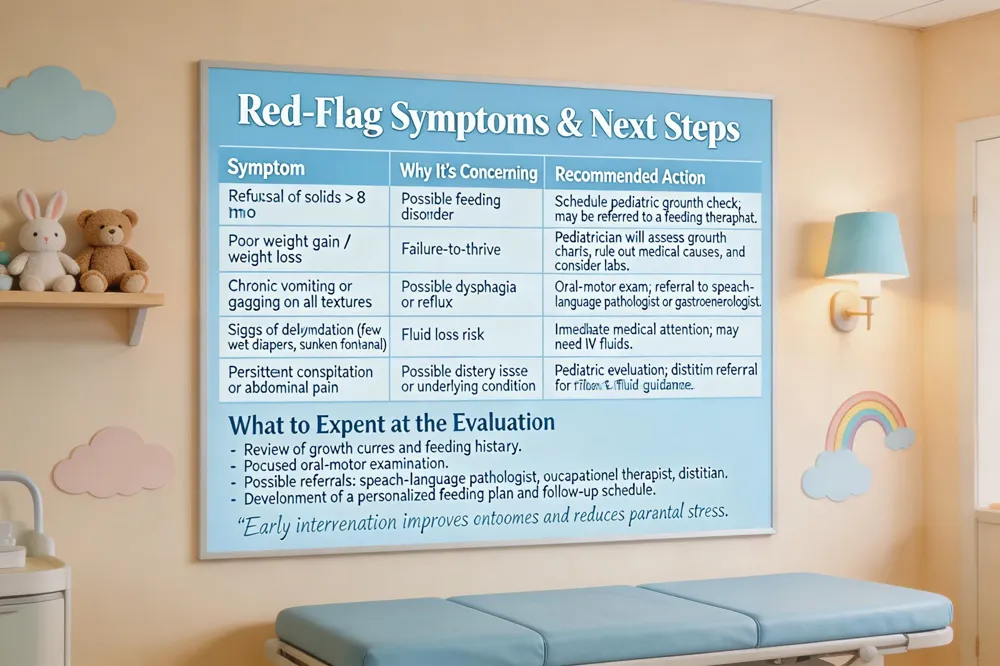 Red‑flag symptoms and referral criteria – Watch for persistent gagging, vomiting, poor weight gain, dehydration, chronic constipation, or a loss of interest in all solids after 8 months. Red‑flag signs such as dysphagia, choking, or failure‑to‑thrive warrant a pediatric evaluation and possible referral to a feeding therapist or occupational therapist.
Pediatric evaluation and feeding therapist role – The pediatrician will review growth charts, conduct a focused oral‑motor exam, and rule out medical causes (e.g., reflux, tongue‑tie). If a feeding disorder is suspected, an interdisciplinary team—including a speech‑language pathologist, occupational therapist, and dietitian—will provide skill‑building, texture progression, and strategies to create a calm, responsive mealtime environment.
ICD‑10 coding for feeding problems – Newborn feeding issues are coded under P92 (e.g., P92.2 slow feeding, P92.3 underfeeding). For infants older than 28 days, use R63.3 (feeding difficulties) with sub‑codes R63.31 acute pediatric feeding disorder or R63.32 chronic pediatric feeding disorder. Non‑organic restrictive intake disorders are coded F98.2. Accurate coding ensures proper documentation and reimbursement.
Resources and printable guides – Parents can download the "Feeding Problems in Infants and Children" PDF and the accompanying PPT from our Patient Resources page. These tools outline common concerns, practical home strategies, and when to seek professional help, making it easier to track progress and communicate with healthcare providers.
Practical Tips and Resources for Parents
Everyday Tips & Helpful Resources
| Tip | How to Implement |
|---|---|
| Modeling meals | Eat the same foods you offer the baby; describe colors and flavors aloud. |
| Baby‑led weaning (≈9 mo) | Provide soft, graspable pieces (banana, cooked veggie sticks, shredded cheese). |
| Consistent routine | Feed at similar times each day in a calm setting; limit distractions (no screens). |
| Hydration | Offer 4‑8 oz plain water in a cup after milk feeds. |
| Track progress | Use a simple feeding log (date, food, amount, baby's reaction). |
Printable Guides
- Parenting Guide to Baby Nutrition – PDF with portion sizes & vitamin D recommendations.
- 6‑to‑12‑month Baby Food Chart – PDF outlining daily milk, water, and solid portions.
- Feeding Problems in Infants PPT – Slides on signs, home strategies, and when to seek help.
All resources are available on the Patient Resources page of the website.
Remember: patience and consistency are key; celebrate small successes!
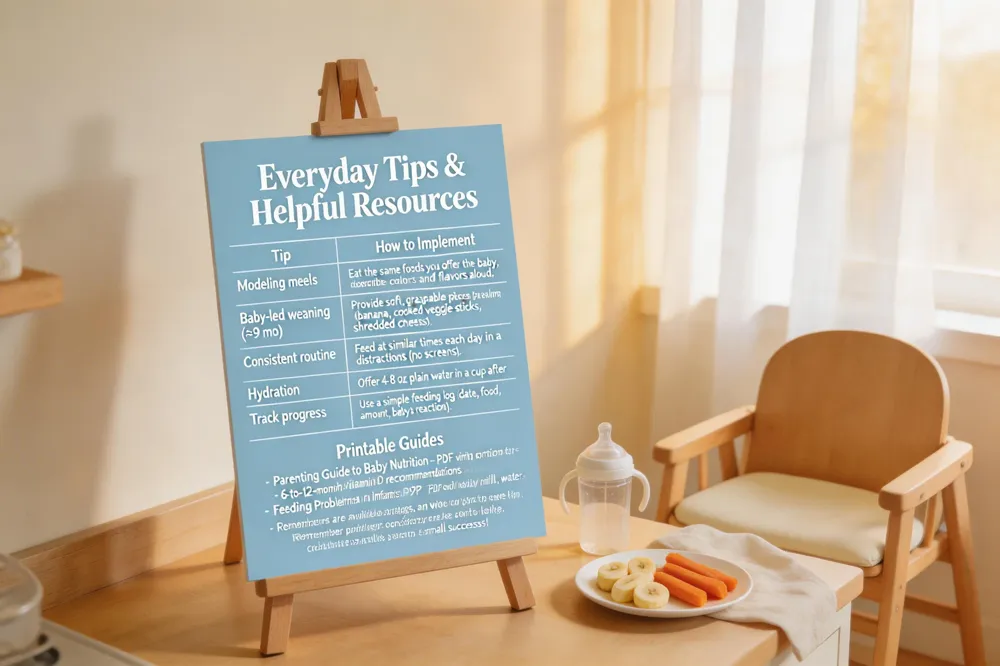 Modeling and Family Meals – Babies learn by watching. Eat the same nutritious foods you offer the baby, describe colors and flavors, and let the child see you chewing. This social cue encourages interest and reduces neophobia.
Self‑Feeding and Baby‑Led Weaning – Around 9 months, offer soft finger foods sized to the baby’s grasp (e.g., cooked veggie sticks, ripe banana). Allow the infant to explore with hands and a spoon, reinforcing motor‑skill development while you stay nearby for safety.
Printable Guides and Online Resources – Download the Parenting Guide to Baby Nutrition PDF for feeding charts, portion sizes, and vitamin D recommendations. A 6‑to‑12‑month Baby Food Chart PDF and a Feeding Problems in Infants PPT are also available for quick reference.
FAQ
- How to help a baby that won’t eat? Confirm readiness (sit‑up, reduced tongue‑thustrust reflex), offer a small repeated portion in a calm routine, model eating, and contact your pediatrician if refusal persists.
- Parenting advice for baby nutrition PDF? Exclusive milk for 6 months, then gradual introduction of iron‑rich purees, safe textures, and avoidance of honey, cow’s milk, and added sugars. See the downloadable PDF for detailed guidance.
- 6‑to‑12‑month baby food chart PDF? Available from Healthy Eating Research, it outlines daily milk, water, and solid‑food portions, plus transition tips from purees to finger foods.
- Feeding problems in infants PPT? Covers under‑ and over‑feeding signs, gagging, vomiting, and management strategies; useful for visual learning and discussion with healthcare providers.
Putting It All Together: A Positive Path Forward
Keeping a close eye on your child’s growth curve and hydration status is the first line of defense—track weight, length, head‑circumference, wet‑diaper count and any signs of dehydration such as dry mouth or lethargy. Pair this monitoring with responsive feeding: offer small, age‑appropriate portions, watch for hunger cues (opening the mouth, reaching) and fullness cues (turning away, pushing food aside), and create a calm, distraction‑free mealtime where the caregiver models eating. If the baby consistently refuses solids, shows persistent gagging, poor weight gain, or any red‑flag symptoms (vomiting, choking, failure to thrive), schedule a pediatric evaluation promptly; a feeding therapist or occupational therapist may be needed. Finally, take advantage of the many practice‑based resources—clinic handouts, downloadable guides, and web‑based tools from trusted organizations such as the AAP, CDC, and local WIC programs—to reinforce healthy habits at home and ensure your child stays on a thriving nutritional path.