Understanding Urgent Care vs. Emergency Care for Children
Pediatric urgent‑care clinics and hospital emergency departments both treat kids, but they serve different needs. Urgent‑care centers handle non‑life‑threatening problems—minor cuts that need stitches, ear infections, sprains, simple fractures, mild asthma or wheezing, rashes, and fevers that are not extreme—while offering faster wait times, lower cost, and a child‑focused environment. Emergency departments are reserved for true emergencies: infants under 2 months with fever, button‑battery ingestion, severe burns, head injuries with loss of consciousness, difficulty breathing, seizures, uncontrolled bleeding, or signs of severe dehydration. In everyday illness, a child’s primary care pediatrician should be the first contact for routine check‑ups, vaccinations, and low‑grade fevers, but after hours the pediatrician’s office is unavailable, urgent‑care is the appropriate next step. Choosing pediatric‑specific facilities matters because staff are trained in children’s anatomy, dosage limits, and communication styles, ensuring safety, comfort, and accurate treatment for every age group.
Locating Pediatric Urgent Care in the Atlanta Metro Area
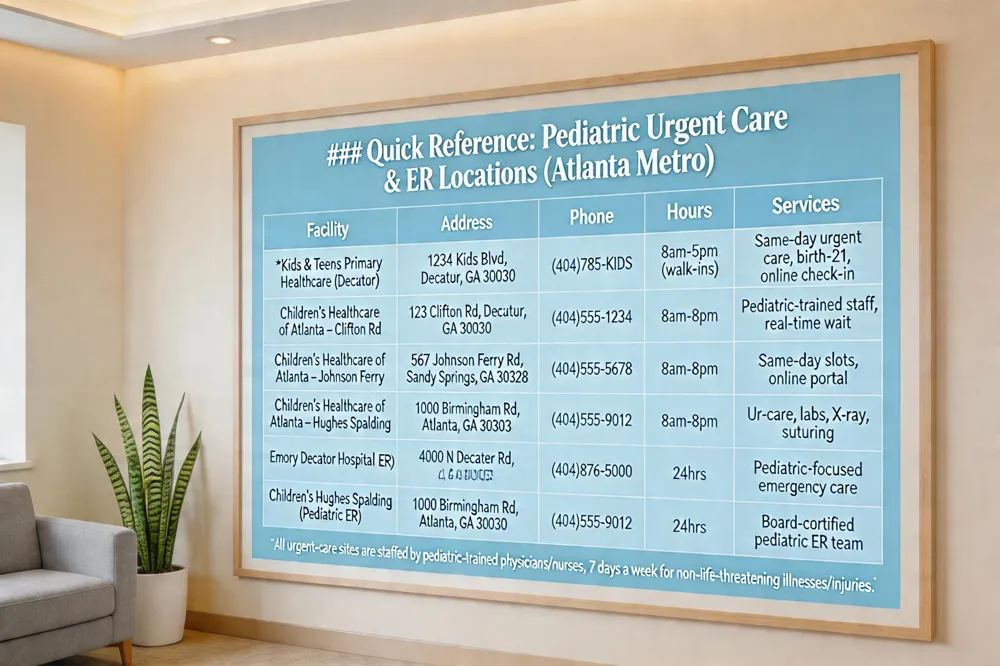
Quick Reference: Pediatric Urgent Care & ER Locations (Atlanta Metro)
| Facility | Address | Phone | Hours (7 days) | Services |
|---|---|---|---|---|
| Kids & Teens Primary Healthcare (Decatur) | 1234 Kids Blvd, Decatur, GA 30030 | (404) 785‑KIDS (5437) | 8 am‑5 pm (walk‑ins) | Same‑day urgent care, birth‑21, online check‑in |
| Children’s Healthcare of Atlanta – Clifton Road | 123 Clifton Rd, Decatur, GA 30030 | (404) 555‑1234 | 8 am‑8 pm | Pediatric‑trained staff, real‑time wait display |
| Children’s Healthcare of Atlanta – Johnson Ferry Road | 567 Johnson Ferry Rd, Sandy Springs, GA 30328 | (404) 555‑5678 | 8 am‑8 pm | Same‑day slots, online portal |
| Children’s Healthcare of Atlanta – Hughes Spalding (Grady Hospital) | 1000 Birmingham Rd, Atlanta, GA 30303 | (404) 555‑9012 | 8 am‑8 pm | Ur‑care, labs, X‑ray, suturing |
| Emory Decatur Hospital (Nearest ER) | 4000 N Decatur Rd, Decatur, GA 30033 | (404) 876‑5000 | 24 hrs | Pediatric‑focused emergency care |
| Children’s Healthcare of Atlanta – Hughes Spalding Hospital (Pediatric ER) | 1000 Birmingham Rd, Atlanta, GA 30303 | (404) 555‑9012 | 24 hrs | Board‑certified pediatric emergency team |
All urgent‑care sites are staffed by pediatric‑trained physicians and nurses and operate seven days a week for non‑life‑threatening illnesses and minor injuries.
Where can I find pediatric urgent care near me in the Atlanta area?
Kids & Teens Primary Healthcare in Decatur, GA offers same‑day pediatric urgent‑care for children from birth through age 21. Walk‑ins are welcome during regular office hours, and appointments can be booked instantly through the online portal. For additional options, Children’s Healthcare of Atlanta runs three dedicated urgent‑care centers: the Clifton Road (Egelston) location, the Johnson Ferry Road site near Northside Hospital, and the Hughes Spalding campus at Grady Hospital. Real‑time wait‑time displays and online check‑in are available on the Children’s Health of Atlanta website; you can also call 404‑785‑KIDS (5437) for the Decatur clinic. All locations are staffed by pediatric‑trained physicians and nurses and operate seven days a week for non‑life‑threatening illnesses and minor injuries.
Where is the nearest emergency room for families in Decatur, GA?
The closest ER is Emory Decatur Hospital at 4000 N Decatur Rd, Decatur, GA 30033 (phone (404) 876‑5000). It provides pediatric‑focused emergency care with board‑certified staff. For a larger pediatric ER a short drive away is Children’s Healthcare of Atlanta – Hughes Spalding Hospital in downtown Atlanta. If you’re unsure which level of care is needed, call the Kids & Teens Primary Healthcare clinic for triage guidance.
Urgent Care for Your Toddler: What to Expect
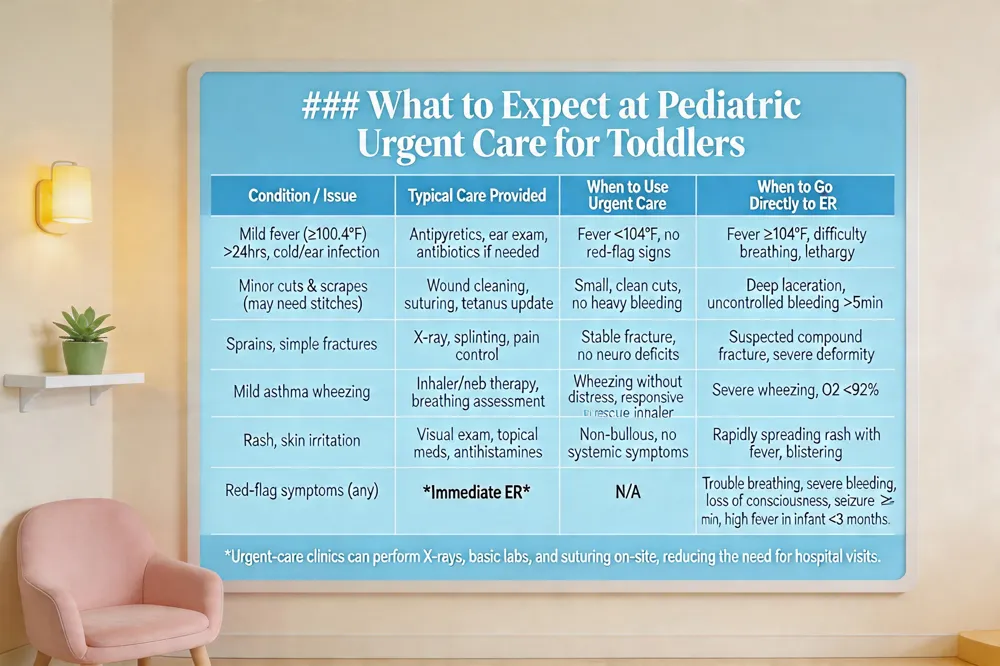
What to Expect at Pediatric Urgent Care for Toddlers
| Condition / Issue | Typical Care Provided | When to Use Urgent Care | When to Go Directly to ER |
|---|---|---|---|
| Mild fever (≥ 100.4 °F) lasting > 24 hrs, cold symptoms, ear infection | Antipyretics, ear exam, antibiotics if needed | Fever < 104 °F, no red‑flag signs | Fever ≥ 104 °F, difficulty breathing, lethargy |
| Minor cuts & scrapes (may need stitches) | Wound cleaning, suturing, tetanus update | Small, clean cuts, no heavy bleeding | Deep laceration, uncontrolled bleeding > 5 min |
| Sprains, simple fractures | X‑ray, splinting, pain control | Stable fracture, no neuro deficits | Suspected compound fracture, severe deformity |
| Mild asthma wheezing | Inhaler/neb‑ therapy, breathing assessment | Wheezing without distress, responsive to rescue inhaler | Severe wheezing, O2 < 92 % |
| Rash, skin irritation | Visual exam, topical meds, antihistamines | Non‑bullous, no systemic symptoms | Rapidly spreading rash with fever, blistering |
| Red‑flag symptoms (any) | Immediate ER | N/A | Trouble breathing, severe bleeding, loss of consciousness, seizure > 2 min, high fever in infant < 3 months |
Urgent‑care clinics can perform X‑rays, basic labs, and suturing on‑site, reducing the need for hospital visits.
 Pediatric urgent‑care clinics are ideal for non‑life‑threatening toddler issues such as mild fevers with cold symptoms, ear infections, minor cuts that may need stitches, sprains, simple fractures, mild asthma wheezing, and rashes. Most centers offer same‑day appointments through an online portal or phone line, and walk‑ins are welcome, so you can be seen quickly without a scheduled visit. If the office is closed, an after‑hours nurse triage line can help you decide whether urgent care or the ER is appropriate, directing you to the nearest pediatric urgent‑care site when needed.
What should I do if my toddler needs urgent care? Call (404) 555‑1234 or use the online portal for a same‑day slot; if unavailable, bring your child to a pediatric urgent‑care center for the conditions listed above. Urgent‑care clinics can perform X‑rays, basic labs, and suturing on‑site, reducing hospital visits. For life‑threatening signs—trouble breathing, severe bleeding, loss of consciousness, high fever that won’t break, or serious injury—call 911 or go straight to the ER.
When should I bring my child to urgent care for a fever? If your child is ≥3 months old with a fever ≥100.4 °F (38 °C) that persists beyond 24 hours, or fever ≥102 °F (38.9 °C) lasting more than a day, especially with dehydration, rash, ear pain, persistent vomiting, or irritability. Infants <3 months with any fever need emergency evaluation.
When should I take my child to urgent care for a cough? Seek care if the cough lasts >1 week, is accompanied by high fever, colored mucus, vomiting, headaches, disrupted sleep, wheezing, a whooping sound, or bluish lips. Severe breathing difficulty or coughing up blood requires 911 and ER care.
Fever in Young Children: Urgent Care vs. Emergency Department
Fever Management: When to Choose Urgent Care vs. ER
| Age Group | Fever Threshold for Urgent Care | Fever Threshold for ER | Red‑Flag Symptoms Requiring ER |
|---|---|---|---|
| < 2 months | ER for any temperature ≥ 100.4 °F (38 °C) | N/A | Any fever, poor feeding, lethargy |
| 2 months – 3 years | Fever ≥ 100.4 °F (38 °C) | Fever ≥ 104 °F (40 °C) or fever ≥ 102 °F (38.9 °C) lasting > 24 hrs despite meds | Dehydration, persistent vomiting, rash, stiff neck, seizure, severe pain, breathing difficulty |
| > 3 years | Fever ≥ 100.4 °F (38 °C) | Fever ≥ 104 °F (40 °C) or any red‑flag sign | Same red‑flags as above |
Five General Danger Signs (IMNCI)
- Unable to drink or breast‑feed
- Persistent vomiting / inability to keep fluids down
- Convulsions or seizures
- Lethargy or unconsciousness
- Severe breathing difficulty or wheezing
Any of these signs merit immediate emergency evaluation.
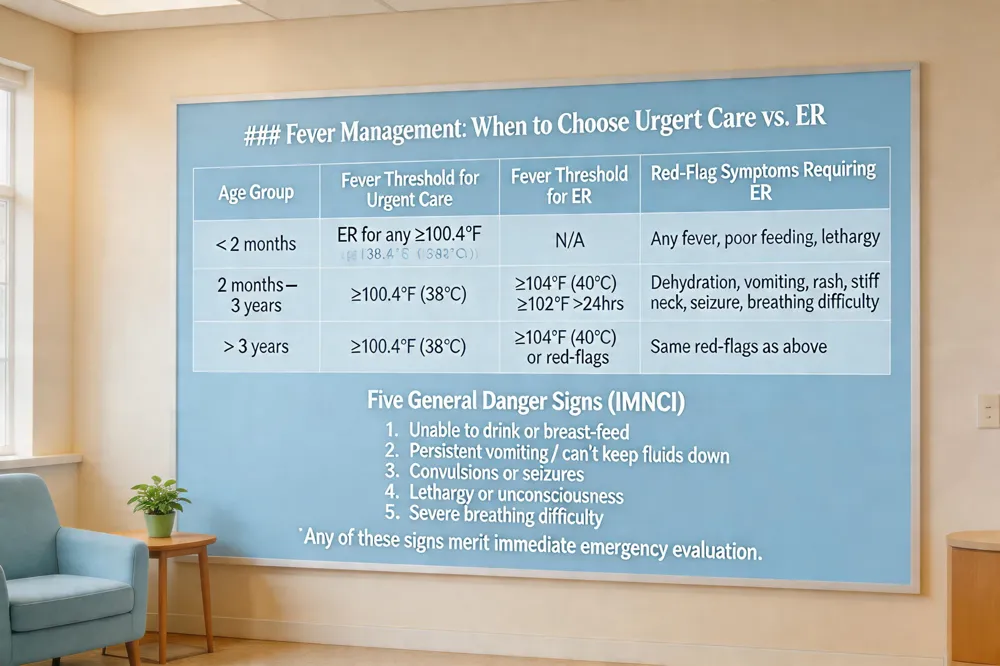 Age‑specific fever thresholds guide where to seek care. Infants under 2 months need the ER for any temperature ≥ 100.4 °F (38 °C). Children 2 months‑3 years are usually fine at pediatric urgent care for fevers ≥ 100.4 °F, but the ED is warranted if the fever hits 104 °F (40 °C) or stays above 102 °F (38.9 °C) for more than 24 hours despite medication.
Red‑flag symptoms that push a fever into the emergency realm include dehydration (dry diapers, few wet diapers, dark urine), persistent vomiting, a rapidly spreading rash, stiff neck, severe pain, difficulty breathing, or a seizure lasting longer than two minutes.
Five general danger signs (IMNCI) are: 1) unable to drink or breast‑feed, 2) persistent vomiting or inability to keep fluids down, 3) convulsions or seizures, 4) lethargy or unconsciousness, and 5) severe breathing difficulty or wheezing. Any of these demand immediate or a trip to the nearest ER.
When should I take my 2‑year‑old to the hospital for a fever? Take your child to the ER if the fever reaches 104 °F (40 °C) or higher, or stays above 102 °F (39 °C) for over 24 hours despite medication, especially with dehydration, rash, stiff neck, vomiting, severe pain, breathing trouble, or a seizure 2 minutes. Call your pediatrician if the fever persists >4 days or any concerning signs appear; trust your instincts and seek professional assessment promptly.
Coughs and Breathing Trouble: When to Seek Emergency Care
Cough & Breathing Trouble: ER vs. Urgent Care
| Symptom / Sign | Recommended Action |
|---|---|
| Difficulty breathing, wheezing, or audible struggle | Go to ER (possible asthma exacerbation, airway obstruction) |
| Choking or inability to clear airway | ER (airway emergency) |
| Seizure | ER |
| Fever ≥ 100.4 °F in infant < 2 months | ER |
| Fever with stiff neck | ER (possible meningitis) |
| Cough lasting > 1 week with high fever, colored mucus, vomiting, headache, disrupted sleep, wheezing, whooping sound, or bluish lips | Urgent Care (evaluate for pneumonia, bronchiolitis) |
| Severe coughing up blood | ER |
| Mild cough, no red‑flags | Urgent Care or pediatrician |
If any red‑flag signs are present, seek emergency care immediately.
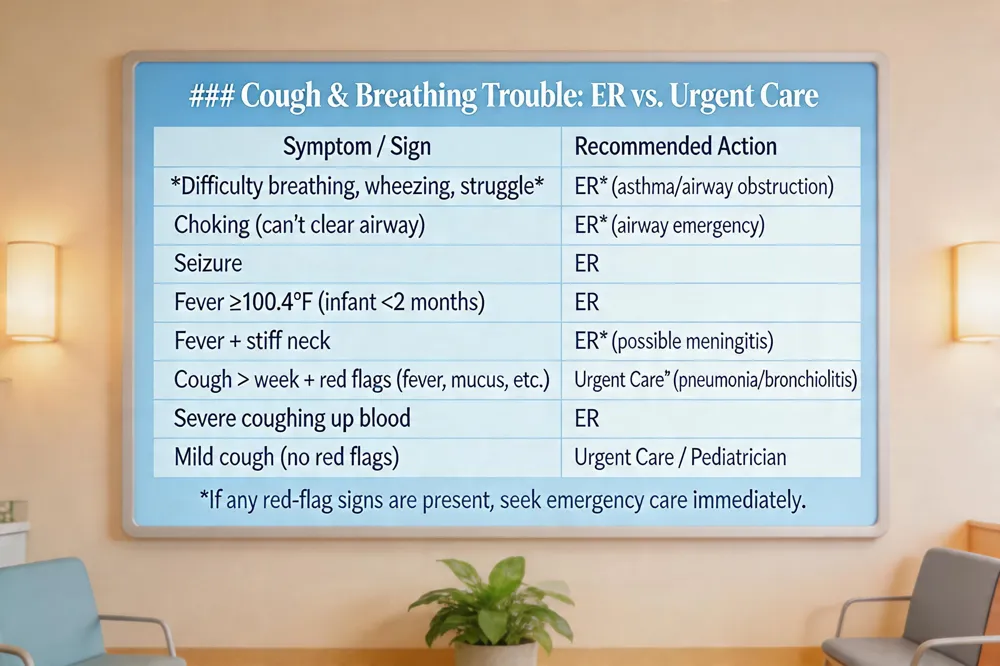 When a child shows any of the following, go straight to the emergency department: difficulty breathing, choking, seizures, a fever ≥ 100.4 °F in a baby under two months, or a fever with stiff neck. Injuries like possible fractures, deep wounds that won’t stop bleeding after five minutes, large burns, or head trauma with loss of consciousness are emergencies. Anaphylaxis—marked by swelling, hives, or trouble breathing—also requires immediate ER care. If none of these red‑flags are present, pediatric urgent care or a pediatrician’s office can usually manage the illness.
Serious Conditions: Dehydration, Trauma, and Shaken‑Baby Syndrome
Serious Pediatric Conditions: When to Go to the ER
| Condition | Key Warning Signs | Recommended Level of Care |
|---|---|---|
| Moderate‑to‑Severe Dehydration | Lethargy, inability to arouse, dry sticky mouth, absent tears, sunken eyes/fontanelle, < 6 wet diapers/24 hrs, dark urine, rapid heartbeat (> 110 bpm), pale/blotchy skin, fast breathing | ER (IV fluids, labs) |
| Trauma (possible fractures, deep wounds, burns, head injury) | Visible deformity, uncontrolled bleeding > 5 min, large burn > 2 % body surface, loss of consciousness, vomiting after head injury | ER (imaging, specialist care) |
| Shaken‑Baby Syndrome | Irritability, lethargy, seizures, vomiting, bulging fontanelle, retinal hemorrhages, bruising, breathing difficulty | ER (CT/MRI, neurosurgical evaluation) |
| Minor injuries (small cuts, sprains, bruises) | Clean cuts, stable sprain, no neuro deficits | Urgent Care |
For any of the above serious signs, transport the child to the nearest pediatric emergency department without delay.
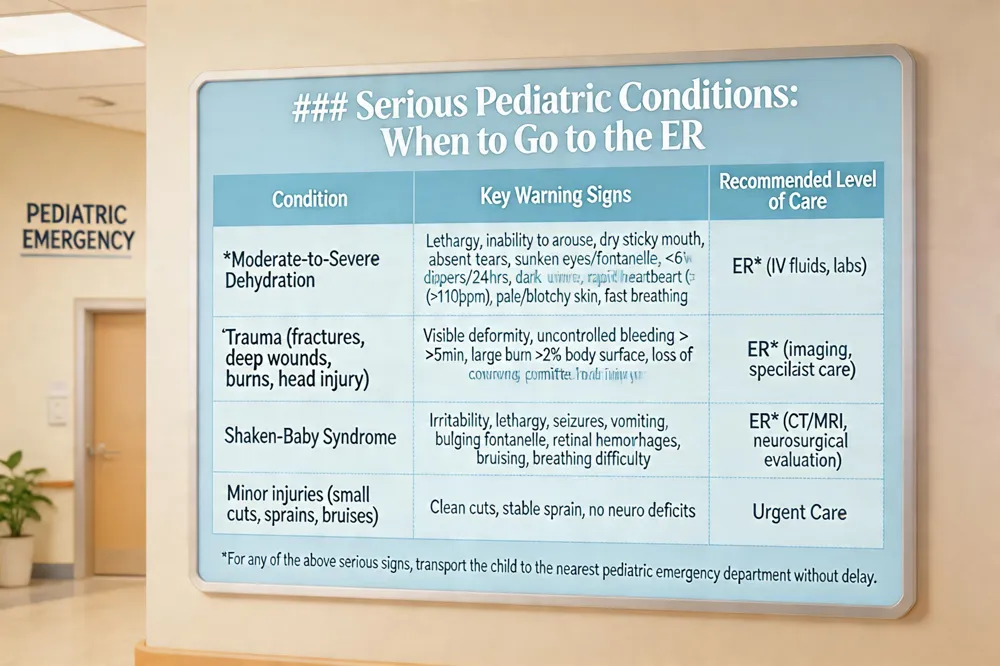 Recognizing moderate‑to‑severe dehydration is key: look for lethargy, an inability to be aroused, a limp unresponsive child, absent tears, a dry or sticky mouth, sunken eyes or fontanelle, and markedly reduced urine output (fewer than six wet diapers in 24 hours) or dark urine. A rapid heartbeat (>110 bpm), pale or blotchy skin, and fast breathing are additional red flags. If your child refuses fluids for several hours, vomits repeatedly, or shows any of these signs, go straight to a pediatric emergency department. Yes—you can (and should) bring your child with you to the ER; the staff will triage immediately in a child‑friendly setting with pediatric‑trained physicians. When a baby is violently shaken, the brain slams against the skull, tearing delicate blood vessels and causing subdural or subarachnoid bleeding, brain bruising, and retinal hemorrhages. Swelling raises intracranial pressure, risking permanent neurologic damage, so urgent medical evaluation and imaging are essential.
Key Takeaways for Parents
Whenever your child’s pediatrician office is closed, a pediatric urgent‑care center is the right choice for minor cuts, ear infections, sprains, mild fevers, or a rash that isn’t worsening. However, certain red‑flag signs demand immediate emergency‑room care: fever ≥ 100.4 °F in infants under two months, difficulty breathing, bluish lips, persistent vomiting, severe dehydration, loss of consciousness, seizures lasting longer than five minutes, or any suspected ingestion of button batteries or poison. In the Atlanta region, families can rely on Children’s Healthcare of Atlanta Urgent Care for quick, child‑focused treatment and the nearby Children’s Hospital Atlanta Emergency Department for true emergencies for your child’s safety today.