Why a First Visit Checklist Matters
Bringing a well‑prepared checklist to your baby’s first pediatric appointment does more than keep paperwork in order—it lays the foundation for a lasting medical home. When insurance cards, photo ID, birth certificate and immunization records are ready, check‑in flows quickly, freeing time for the clinician to focus on your child’s health. A clear list of questions and a stocked diaper bag let the pediatrician address feeding, sleep, safety and developmental milestones without interruptions, turning the visit into a proactive preventive‑care session. This organized start builds trust, ensures accurate growth tracking, and sets a schedule for future well‑child visits, giving your child the best chance for healthy growth and early detection of any concerns and peace of mind for the family.
Essential Documents and Items to Bring
Essential Documents & Items Checklist
| Document / Item | Why It’s Needed |
|---|---|
| Birth certificate or discharge papers | Proof of birth for medical records |
| Immunization records | Track vaccines already received |
| Medication list | Current meds, dosages, and allergies |
| Insurance card | Billing and eligibility verification |
| Photo ID (driver’s license, passport) | Identity verification |
| Completed new‑patient form (if provided) | Streamlines registration |
| Comfort item (blanket, toy) | Helps soothe the baby during exam |
| Written list of questions (feeding, sleep, development, vaccines) | Ensures you cover all concerns |
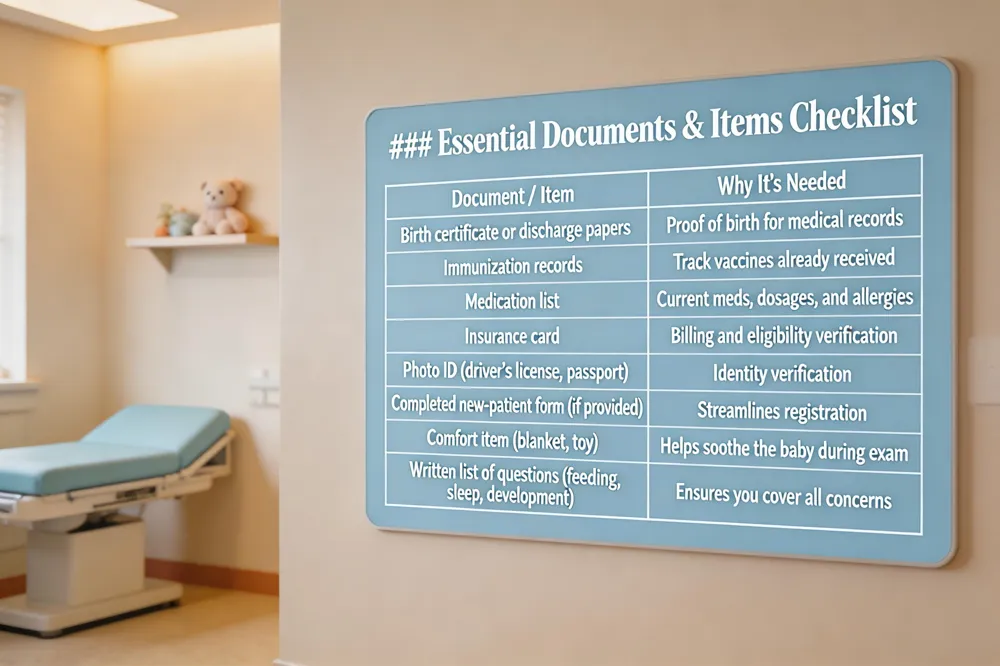 What should I bring to my child's first pediatrician appointment? Bring the birth certificate or discharge papers, immunization records, a medication list, insurance card, photo ID, and a completed new‑patient form if provided. Add a comfort item and a written list of questions about feeding, sleep, development, or vaccines.
What items are included in a well‑child visit checklist for providers? Providers review birth, feeding, sleep, elimination, nutrition, dental care, and safety practices; they perform a head‑to‑toe exam with weight, length/height, and head‑circumference measurements plotted on growth charts; they conduct developmental surveillance (using formal tools at 9, 18, 30 months), vision and hearing screens, update immunizations, and give anticipatory guidance on injury prevention, nutrition, sleep, and psychosocial health. They also screen for postpartum depression and any signs of abuse, documenting referrals as needed.
What Happens During the First Appointment
First Newborn Visit Overview
| Activity | Details |
|---|---|
| Vital measurements | Weight, length, head circumference plotted on growth chart |
| Head‑to‑toe physical exam | Fontanel, eyes, ears, heart, lungs, abdomen, hips, reflexes |
| Developmental surveillance | Ages & Stages Questionnaire (or M‑CHAT‑R/F for autism risk) |
| Newborn screening review | Hearing, metabolic, jaundice results |
| Vaccination review & administration | First dose of Hepatitis B (if not given in hospital) |
| Safety & anticipatory guidance | Safe‑sleep positioning, rear‑facing car‑seat, vitamin D, postpartum‑depression screening |
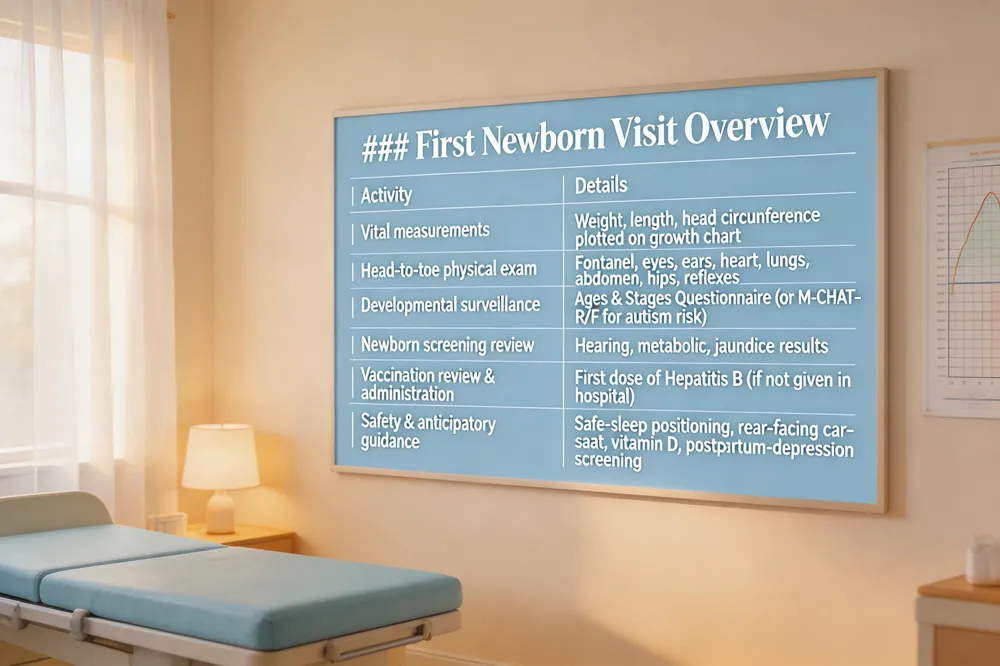 During the newborn’s first well‑child visit (usually 3‑5 days after birth) the pediatrician begins by measuring weight, length, and head circumference and plotting these numbers on a growth chart. A comprehensive head‑to‑toe physical exam follows, checking the fontanel, eyes, ears, heart, lungs, abdomen, hips, and reflexes. Developmental surveillance is performed using tools such as the Ages & Stages Questionnaire, and for older infants the M‑CHAT‑R/F may be used to screen for autism risk. The doctor reviews newborn screening results (hearing, metabolic, jaundice) and discusses any abnormal findings. Vaccination review is a key component; if the infant did not receive hepatitis B in the hospital, the first dose is given at this visit, and the provider explains the upcoming vaccine schedule (DTaP, Hib, PCV13, IPV, rotavirus, influenza, etc.). Safety and anticipatory guidance round out the encounter: safe‑sleep positioning, proper rear‑facing car‑seat installation, feeding basics, vitamin D supplementation, and postpartum‑depression screening for parents.
What happens at the first pediatrician appointment for autism? The pediatrician asks detailed questions about developmental milestones, communication, and social interaction, then uses a standardized tool like the M‑CHAT‑R/F to assess autism risk. Results guide referrals to developmental specialists and provide parents with next‑step resources.
Which vaccines are given at the first newborn appointment? Typically only the first dose of hepatitis B is administered at the newborn visit; other routine vaccines are scheduled for the 2‑month well‑child visit. The appointment also includes non‑vaccine care such as vitamin K, hearing screening, and parental education.
Well‑Child Visit Schedule and Intervals
Well‑Child Visit Schedule (AAP Bright Futures)
| Age | Visit Focus | Key Milestones / Actions |
|---|---|---|
| 3‑5 days | Newborn check‑up | Weight, length, head circumference; Hep B dose; vitamin K, hearing screen |
| 1 month | Growth & feeding | Weight gain, feeding patterns |
| 2 months | First routine vaccines | DTaP, Hib, PCV13, IPV, rotavirus; developmental screen |
| 4 months | Motor milestones | Rolling, sitting with support |
| 6 months | Growth & solid foods | Sitting, babbling, first solids |
| 9 months | Developmental surveillance | Ages & Stages Questionnaire (9 mo) |
| 12 months | Walking & speech | Independent standing, first words; vaccines (MMR, varicella) |
| 15 months | Growth & safety | Motor skills, car‑seat transition |
| 18 months | Developmental surveillance | Ages & Stages Questionnaire (18 mo) |
| 2 years | Language & behavior | 2‑step commands, potty training |
| 30 months (2½ yr) | Developmental surveillance | Ages & Stages Questionnaire (30 mo) |
| 3 years onward | Annual well‑child visit | Vision/hearing screens, behavior counseling, immunizations (influenza yearly) |
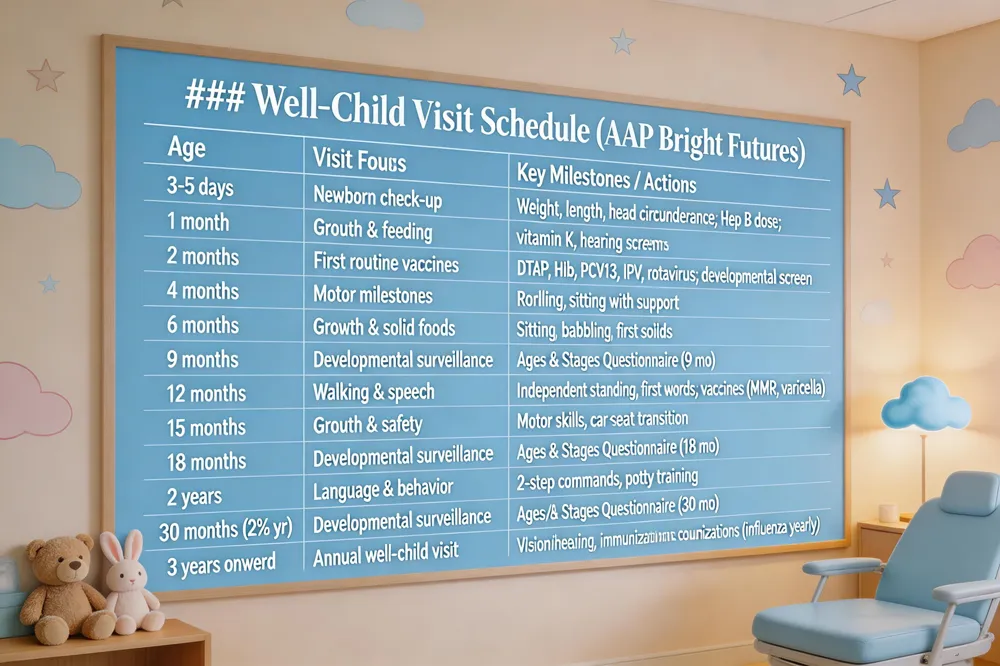
What is the schedule chart for well‑baby visits?
The AAP Bright Futures periodicity schedule (mirroring CDC timing) starts with a newborn check‑up at 3‑5 days, followed by visits at 1 month, 2 months, 4 months, 6 months, 9 months, and 12 months. After the first year, appointments occur at 15 months, 18 months, 2 years, 2½ years (30 months), and 3 years. From age 3 onward, a well‑child visit is scheduled each year through age 21, with slightly longer intervals (1‑2 years) for older teens.
What are the recommended well‑child visit ages and intervals?
Key milestones are assessed at each visit: weight/length and head‑circumference growth at 1, 6, 12 months; motor and language milestones (rolling, sitting, crawling, first words) at 4‑9 months; independent standing and early walking at 12‑15 months; and social‑cognitive skills (pretend play, following two‑step commands) by 18 months. Annual visits after age 3 continue to monitor growth, nutrition, vision, hearing, and safety (car‑seat use, home‑proofing).
What is the standard well‑child visit schedule in the United States?
The United States follows the AAP’s periodicity schedule, which aligns with CDC immunization recommendations. Visits are spaced to provide anticipatory guidance, developmental screenings (e.g., Ages & Stages Questionnaire at 9, 18, 30 months), and timely vaccines (Hep‑B, DTaP, Hib, IPV, PCV13, rotavirus, MMR, varicella, influenza). Preschool‑age children (3‑5 years) still see the pediatrician yearly, while school‑age children (6‑12 years) have annual check‑ups that include vision, hearing, and health‑behavior counseling. This systematic approach ensures a trusted partnership between families and pediatric teams, promoting optimal physical, mental, and social health from birth through adolescence.
Preparing Questions and Follow‑Up
Sample Questions to Ask at the First Visit
| Topic | Example Questions |
|---|---|
| Visit schedule | “What are the recommended well‑child exam ages?” |
| Feeding | “How much should my baby be feeding per day? Breast vs. formula guidance?” |
| Sleep | “What is a safe‑sleep position and how many hours should my infant sleep?” |
| Development | “What milestones should I expect in the next month?” |
| Emergencies | “What is the after‑hours contact procedure for urgent concerns?” |
| Immunizations | “What is the vaccine schedule for the first year?” |
| Resources | “Do you have handouts on newborn care or support groups?” |
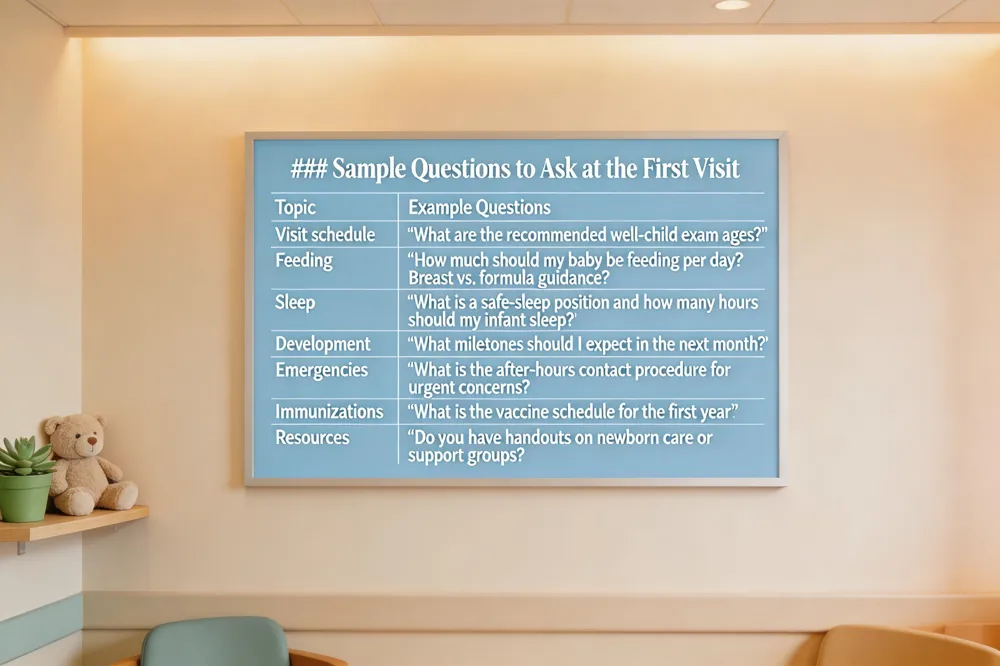 When you walk into your baby’s first pediatrician appointment, coming prepared makes the visit smoother and more productive.
What questions should I ask during my baby's first pediatrician visit? Ask about the schedule for routine well‑child exams, normal feeding patterns, and guidance on breastfeeding or formula. Discuss sleep expectations, safe‑sleep practices, and what amount of crying is typical versus a sign of colic. Clarify the practice’s after‑hours policy, how to reach the pediatrician for urgent concerns, and who covers care when the doctor is unavailable. Finally, request a timeline for immunizations, growth‑tracking milestones, and any newborn‑specific resources the office provides.
What are the five general danger signs in a child that require immediate medical attention? Look for (1) difficulty breathing or a bluish‑purple coloration of lips/skin, (2) severe lethargy or unresponsiveness, (3) seizures or convulsions, (4) persistent projectile or bilious vomiting, and (5) a fever in an infant under three months (or a very high fever ≥ 104 °F/40 °C). Any of these signs merit urgent evaluation.
How can I set up a pediatrician for my baby before birth? Start the search three months before your due date by asking friends, your OB‑GYN, and your insurance for trusted referrals. Verify the doctor is in‑network, board‑certified, and has hospital privileges at your birthing hospital. Arrange a prenatal "meet‑and‑greet" to tour the office, meet the care team, and discuss newborn care, vaccination schedules, and after‑hours communication. Confirm paperwork and insurance details so the pediatrician is ready to be your child’s primary care provider from day one.
Quick tips: Create a concise list of 3‑5 questions, bring a notebook or phone for note‑taking, and ask about post‑visit resources such as support groups or therapy options if needed. Having these elements ready ensures you leave the appointment feeling informed and confident about your baby’s health journey.
Additional Resources and Printable Tools
Printable Resources & Links
| Resource | Link / Description |
|---|---|
| Bright Futures Well‑Child Visit Templates | https://brightfutures.aap.org (free PDFs for each age) |
| Stanford Medicine Pediatric Primary Care Forms | https://med.stanford.edu/pediatrics (downloadable encounter PDFs) |
| AAP Parent‑Education Handouts | https://www.aap.org/en-us/Pages/Parent-Education.aspx (English & Spanish) |
| Printable Checklist for First Visit | https://nortonchildrens.com/checklist (birth certificate, meds, comfort item) |
| Developmental Screening Tools (Ages & Stages, M‑CHAT) | https://www.healthychildren.org (online and printable versions) |
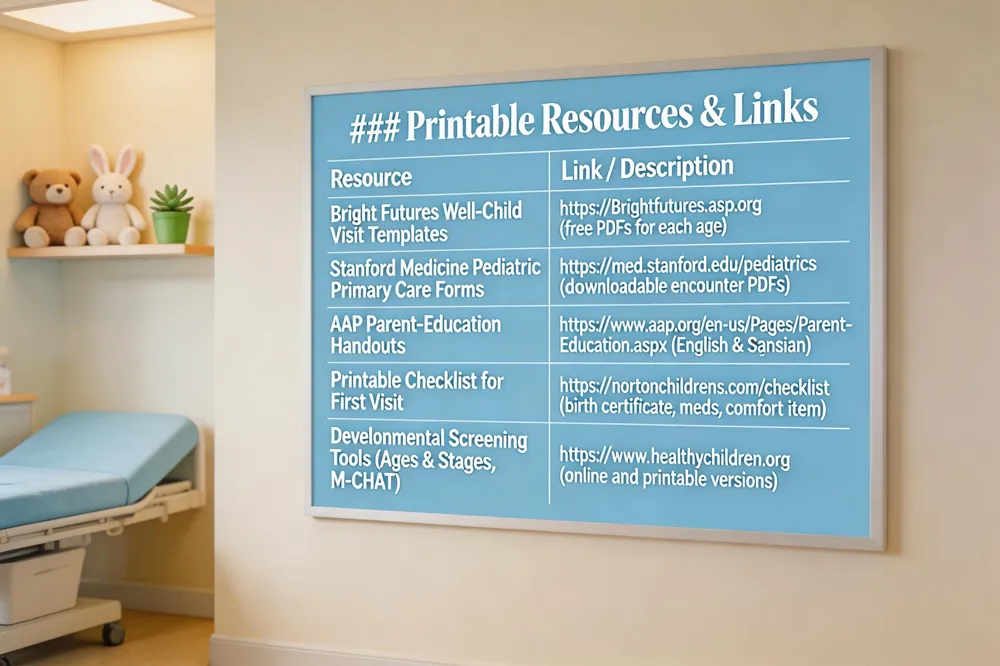 Having the right paperwork on hand makes every well‑child visit smoother and more productive. Below are quick answers to common questions about printable templates, scheduling, and legal aspects.
Is there a printable template for a pediatric well‑child visit? Yes—many pediatric practices provide printable well‑child‑visit templates, and you can download ready‑to‑print PDFs from reputable sources. Stanford Medicine’s Pediatric Primary Care portal offers a full set of encounter forms for every age, ranging from newborn to adolescent visits, all of which can be printed and used in the office. The American Academy of Pediatrics’ Bright Futures handouts also include printable parent‑education sheets for each well‑child visit, available in English and Spanish (and other languages for younger ages). If you need a custom template for Kids & Teens Primary Healthcare, you can adapt these standardized forms to match your office’s workflow and branding.
Where can I find a free printable well‑child visit template? You can download free, printable well‑child visit templates directly from the AAP Bright Futures online. State health‑department sites and pediatric clinics such as Peach Clinic also host “Bright Futures” check‑up forms that are freely available for download. Stanford Medicine’s Pediatric Primary Care page lists a full series of well‑child encounter PDFs that can be printed without charge.
Should I schedule a pediatrician appointment before or after my baby is born? It’s best to start looking for a pediatrician during the third‑trimester and, if possible, schedule a meet‑and‑greet before birth. This ensures a provider is ready within 48‑72 hours after discharge. If you haven’t secured a doctor before birth, you can still arrange the first office visit within the first week.
Are well‑child visits required by law in the United States? No single federal statute makes them mandatory for every child. However, many state regulations require health examinations for children in licensed care programs, foster care, or Medicaid/CHIP under the EPSDT program. Participation is not a blanket legal mandate, but specific contexts do require timely visits.
Putting It All Together for a Successful First Visit
Before you walk into the office, run through the checklist one more time—insurance card, photo ID, birth certificate, immunization record, and any medication bottles. Keep these papers in a dedicated folder so you can hand them over without scrambling. Write down three to five questions about feeding, sleep, diaper output, or family history, and bring a notebook or phone to capture the pediatrician’s answers. Use free templates from the American Academy of Pediatrics or reputable parenting sites to organize your notes and track upcoming well‑child appointments. By staying organized and leveraging proven resources, you turn the first visit into a smooth, confidence‑building step toward lifelong preventive care.