Why Tracking Development Matters
Milestones give pediatricians a clear map of a child’s motor, language, social and cognitive growth. When a skill is missed or lost, early screening—recommended by the CDC and AAP at 9, 18 and 30 months—can trigger referrals to specialists and state early‑intervention programs, dramatically improving long‑term outcomes. Kids & Teens Primary Healthcare in Decatur offers printable CDC checklists, a mobile Milestone Tracker, and personalized well‑child visits to discuss any concerns and ensure timely medical attention for your child's healthy future.
Human Development Stages and Age‑Based Milestones
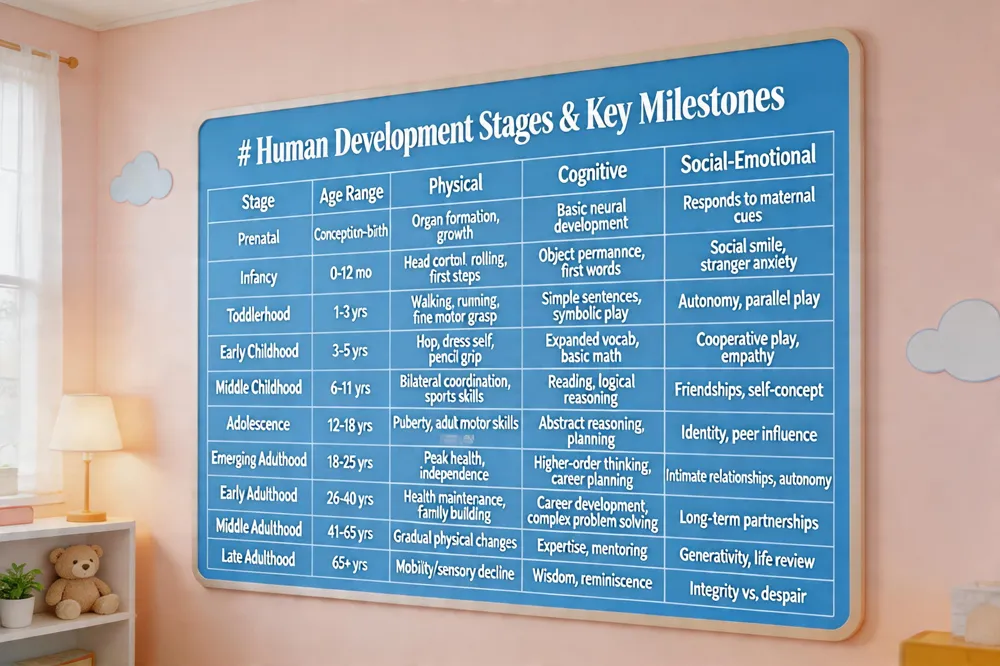
Human Development Stages & Key Milestones
| Stage | Age Range | Physical | Cognitive | Social‑Emotional |
|---|---|---|---|---|
| Prenatal | Conception‑birth | Organ formation, growth | Basic neural development | Begins to respond to maternal cues |
| Infancy | 0‑12 mo | Head control, rolling, sitting, crawling, first steps | Object permanence, babbling, first words | Social smile, stranger anxiety |
| Toddlerhood | 1‑3 yrs | Walking, running, climbing, fine‑motor grasp | Simple sentences, symbolic play, cause‑and‑effect | Autonomy, parallel play |
| Early Childhood (Preschool) | 3‑5 yrs | Hop, skip, dress self, pencil grip | Expanded vocabulary, basic math, imagination | Cooperative play, empathy |
| Middle Childhood | 6‑11 yrs | Bilateral coordination, sports skills | Reading, writing, logical reasoning | Friendships, self‑concept |
| Adolescence | 12‑18 yrs | Puberty, adult‑type motor skills | Abstract reasoning, planning | Identity formation, peer influence |
| Emerging/Young Adulthood | 18‑25 yrs | Peak physical health, independence | Higher‑order thinking, career planning | Intimate relationships, autonomy |
| Early Adulthood | 26‑40 yrs | Maintenance of health, family building | Career development, complex problem solving | Long‑term partnerships |
| Middle Adulthood | 41‑65 yrs | Gradual physical changes | Expertise, mentoring | Generativity, life review |
| Late Adulthood | 65+ yrs | Mobility changes, sensory decline | Wisdom, reminiscence | Integrity vs. despair |
 What are the 7 main stages of human development?
Human development is commonly divided into seven principal stages: 1) Prenatal (conception‑birth), 2) Infancy and Toddlerhood (0‑2 yrs), 3) Childhood (early 2‑6 yrs and middle 6‑12 yrs), 4) Adolescence (13‑19 yrs), 5) Early Adulthood (20‑40 yrs), 6) Middle Adulthood (40‑65 yrs) and 7) Late Adulthood (65+ yrs). Each stage reflects distinct physical, cognitive, and social‑emotional growth.
What are the 7 main stages of human development?
Human development is commonly divided into seven principal stages: 1) Prenatal (conception‑birth), 2) Infancy and Toddlerhood (0‑2 yrs), 3) Childhood (early 2‑6 yrs and middle 6‑12 yrs), 4) Adolescence (13‑19 yrs), 5) Early Adulthood (20‑40 yrs), 6) Middle Adulthood (40‑65 yrs) and 7) Late Adulthood (65+ yrs). Each stage reflects distinct physical, cognitive, and social‑emotional growth.
What are the 7 lifespan stages? The lifespan stages echo the above: infancy (0‑2 yrs), childhood (2‑12 yrs), adolescence (13‑19 yrs), emerging adulthood (18‑25 yrs), early‑and‑middle adulthood (25‑65 yrs) and late adulthood (65+ yrs). These boundaries help clinicians time developmental screenings.
What are the 5 stages of development age? The five major childhood phases are newborn (0‑2 mo), infant (3 mo‑12 mo), toddler (12 mo‑3 yrs), preschooler (3‑5 yrs) and school‑age (5‑12 yrs). Each phase carries specific milestones—smiling and head‑control at 2 mo, walking and first words by 12 mo, climbing and simple sentences by 18 mo, and cooperative play by 4‑5 yrs.
What are the 5 stages of developmental milestones?
- Infancy (0‑12 mo) – motor, language, social basics. 2) Early childhood/toddlerhood (1‑3 yrs) – walking, early speech, independence. 3) Preschool (3‑5 yrs) – expanded language, imaginative play, fine‑motor skills. 4) School‑age (5‑12 yrs) – academic abilities, peer relationships. 5) Adolescence (12‑18 yrs) – abstract reasoning, identity formation.
What are the main life stages by age? Infancy (0‑12 mo), toddlerhood (1‑5 yrs), early childhood (5‑8 yrs), middle childhood (9‑11 yrs), adolescence (12‑18 yrs), and young adulthood (up to 21 yrs).
7 stages of child development with age Prenatal, infancy (0‑12 mo), toddler (1‑3 yrs), early childhood/preschool (3‑5 yrs), middle childhood (6‑11 yrs), adolescence (12‑18 yrs), emerging adulthood/young adult (18‑21 yrs). Pediatricians use CDC’s "Learn the Signs. Act Early" checklists at each age—2 mo, 4 mo, 6 mo, 9 mo, 12 mo, 15 mo, 18 mo, 2 yrs, 30 mo, 3 yrs, 4 yrs, 5 yrs—to screen for delays. If a child misses multiple milestones, loses a previously acquired skill, or parents have concerns, early action—talking with a pediatrician and potentially accessing state‑wide early‑intervention services—can improve long‑term outcomes. Regular well‑child visits and developmental surveillance are essential for keeping every child on a healthy trajectory.
CDC Milestone Charts and Printable Resources
CDC Milestone Charts & Printable Resources
| Resource | Age Range Covered | Domains | Download Link |
|---|---|---|---|
| Learn the Signs. Act Early (Checklists) | Birth‑5 yrs | Gross motor, fine motor, language/social, cognitive | https://www.cdc.gov/act-early/milestones/index.html |
| CDC Printable Milestone Chart (One‑page) | Birth‑5 yrs | All domains (summary) | https://www.cdc.gov/ncbddd/actearly/milestones.html |
| Milestone Moments Booklet | Birth‑3 yrs | Gross motor, language, social | https://www.cdc.gov/act-early/milestones/milestone-moments.pdf |
| AAP Bright Futures (PDF) | Birth‑5 yrs | Social, language, gross & fine motor, cognitive | https://publications.aap.org/DocumentLibrary/Solutions/Toolkits/BFTK-IR/Bright%20Futures%20Milestones%20and%20Anticipatory%20Guidance.pdf |
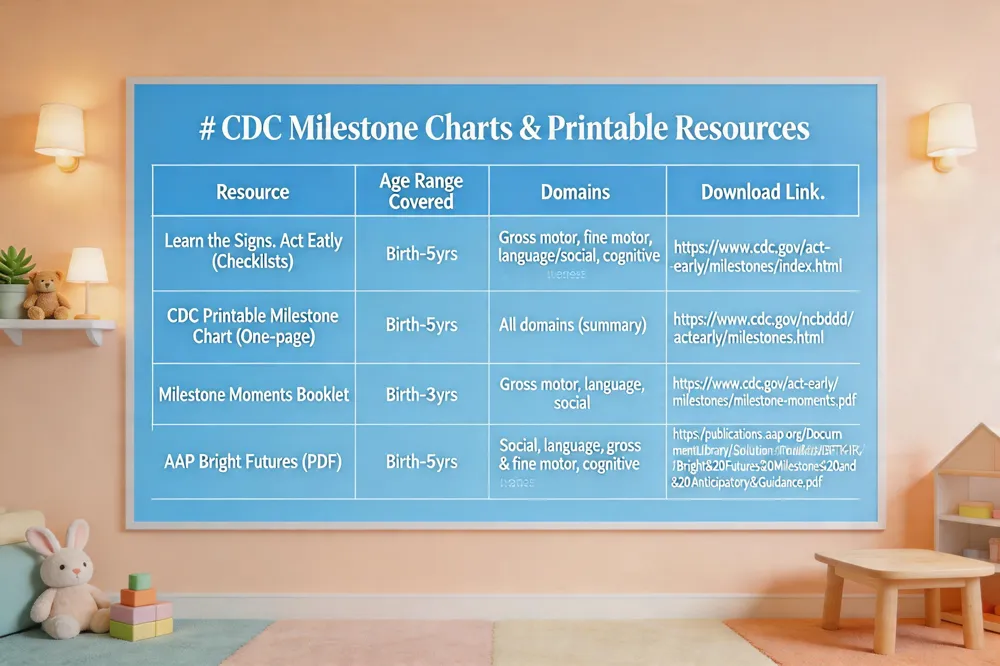 All of these milestones are compiled in a free, downloadable CDC PDF that can be accessed at CDC PDF. The PDF lists age‑by‑age checklists for gross motor, fine motor, language/social, and cognitive domains, and additional printable guides (e.g., the AAP Bright Futures Milestones) are also available online. Parents can print the one‑page chart, hang it on the fridge, and bring it to well‑child visits to track progress and flag concerns early.
From birth to 2 months infants focus on head control, eye tracking, and social smiles. By 4–6 months they roll, sit with support, grasp toys, and babble. At 9–12 months they pull to stand, walk with furniture, say “mama/dada,” and engage in simple pretend gestures. The chart continues through preschool years, showing how children hop, skip, use full sentences, count, draw people, and cooperate in group play by age 5. Using these printable checklists helps families and clinicians catch delays quickly and connect to early‑intervention services, improving long‑term outcomes.
American Academy of Pediatrics Resources
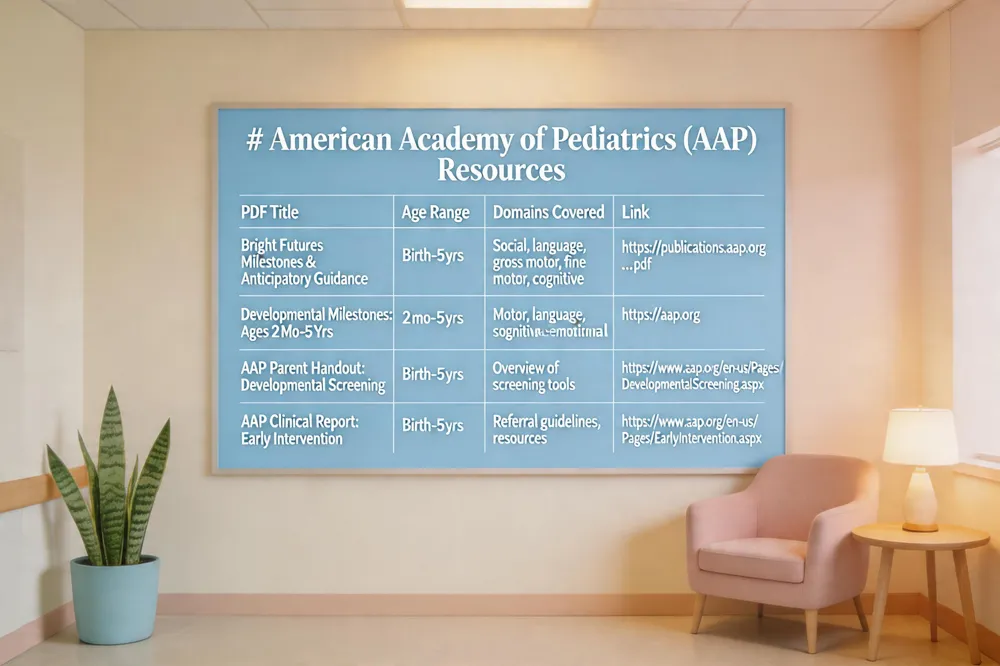
American Academy of Pediatrics (AAP) Resources
| PDF Title | Age Range | Domains Covered | Link |
|---|---|---|---|
| Bright Futures Milestones & Anticipatory Guidance | Birth‑5 yrs | Social, language, gross motor, fine motor, cognitive | https://publications.aap.org/DocumentLibrary/Solutions/Toolkits/BFTK-IR/Bright%20Futures%20Milestones%20and%20Anticipatory%20Guidance.pdf |
| Developmental Milestones: Ages 2 Months to 5 Years | 2 mo‑5 yrs | Motor, language, cognitive, social‑emotional | https://aap.org (example‑link) |
| AAP Parent Handout: Developmental Screening | Birth‑5 yrs | Overview of screening tools | https://www.aap.org/en-us/Pages/DevelopmentalScreening.aspx |
| AAP Clinical Report: Early Intervention | Birth‑5 yrs | Referral guidelines, resources | https://www.aap.org/en-us/Pages/EarlyIntervention.aspx |
 AAP developmental milestone PDFs
The American Academy of Pediatrics (AAP) provides several free, evidence‑based PDFs that outline age‑appropriate developmental milestones. The flagship document is the Bright Futures Milestones and Anticipatory Guidance PDF, which lists social, language, gross‑motor, and fine‑motor milestones from birth through age 5. Another useful resource is the Developmental Milestones: Ages 2 Months to 5 Years patient‑education PDF. Both are publicly accessible through the AAP Publications site and can be printed or viewed on mobile devices.
Free download options
Parents and clinicians can download printable milestone checklists directly from the CDC website (www.cdc.gov/Milestones) where the “Milestone Moments” booklet is offered at no cost. Additional free PDFs are available from university programs such as Stanford and the University of Washington, each providing detailed tables across motor, language, cognitive, and social‑emotional domains. Simply click the “PDF” or “Download” button on the respective pages to save the file.
How pediatricians use the PDFs during visits
During well‑child appointments, pediatricians reference the AAP and CDC PDFs to compare a child’s observed skills with expected milestones. The checklists guide conversations, help identify red‑flag concerns, and support anticipatory guidance for parents. When a child meets most milestones, the clinician reinforces progress; if gaps appear, the provider can arrange early‑intervention referrals or schedule additional screening tools.
American Academy of Pediatrics developmental milestones PDF
The AAP offers the Bright Futures Milestones and Anticipatory Guidance PDF (https://publications.aap.org/DocumentLibrary/Solutions/Toolkits/BFTK-IR/Bright%20Futures%20Milestones%20and%20Anticipatory%20Guidance.pdf) and the Developmental Milestones: Ages 2 Months to 5 Years PDF (https://aap.org) for free download.
Developmental milestones PDF free download
A free, printable PDF is available from the CDC at https://www.cdc.gov/Milestones, with additional resources from Stanford University and the University of Washington.
Month‑by‑Month Milestone Tracking for Parents
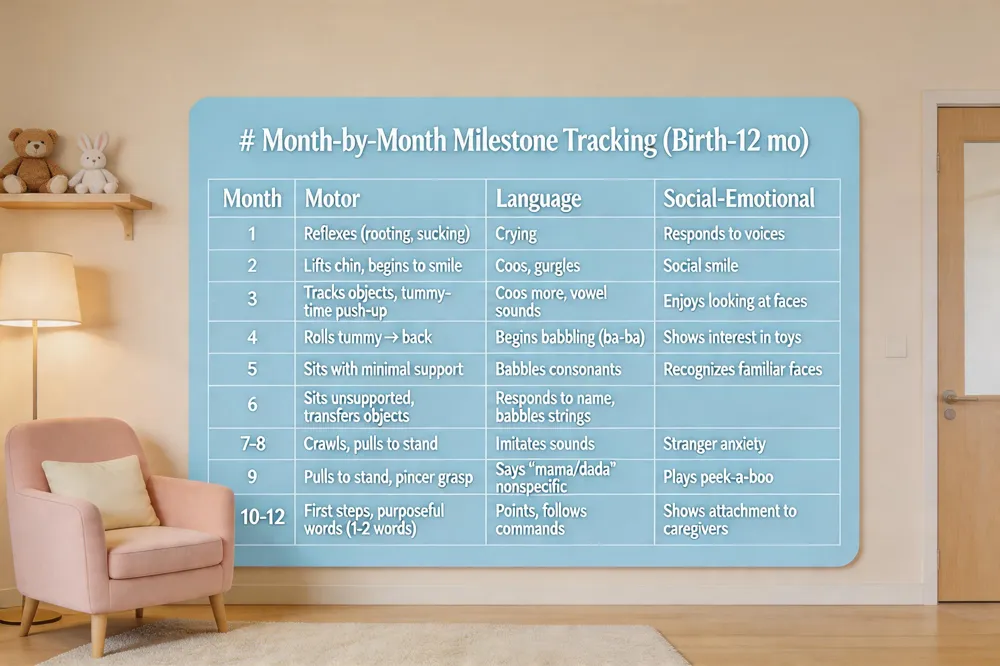
Month‑by‑Month Milestone Tracking (Birth‑12 mo)
| Month | Motor | Language | Social‑Emotional |
|---|---|---|---|
| 1 | Reflexes (rooting, sucking) | Crying | Responds to voices |
| 2 | Lifts chin, begins to smile | Coos, gurgles | Social smile |
| 3 | Tracks objects, tummy‑time push‑up | Coos more, vowel sounds | Enjoys looking at faces |
| 4 | Rolls tummy → back | Begins babbling (ba‑ba) | Shows interest in toys |
| 5 | Sits with minimal support | Babbles consonants | Recognizes familiar faces |
| 6 | Sits unsupported, transfers objects | Responds to name, babbles string | |
| 9 | Pulls to stand, pincer grasp | Says “mama/dada” nonspecific | Plays peek‑a‑boo |
| 10‑12 | First steps, purposeful words (1‑2 words) | Points, follows simple commands | Shows attachment to caregivers |
 Baby milestones month by month
During the first month babies primarily exhibit reflexes (rooting, sucking, startle) and can lift their chin briefly while on their stomach. At two months they begin to smile socially, coo, and briefly hold their head up. By three months infants track objects with their eyes and enjoy tummy‑time, pushing up on forearms. At four months they roll from tummy to back, reach for toys, and babble vowel sounds; at five months they sit with minimal support and explore cause‑and‑effect play. Six‑month olds sit unsupported, transfer objects hand‑to‑hand, respond to their name, and often roll both ways. Seven to eight months bring crawling, pulling to stand, and stranger anxiety. At nine months babies pull to stand, develop a pincer grasp, and say “mama/dada” nonspecifically. By ten to twelve months they typically take first steps, speak purposeful words, and enjoy simple games like peek‑a‑boo.
Practical tracking tips
Parents should use the CDC's Learn the Signs. Act Early. printable checklists or the free Milestone Tracker app, noting each new skill as it appears. Keep a small notebook or digital log, compare observations with the age‑specific lists, and discuss any concerns during well‑child visits.
Role of Kids & Teens Primary Healthcare
Kids & Teens Primary Healthcare in Decatur, Georgia follows the CDC’s "Learn the Signs. Act Early" program, offering regular well‑child exams, developmental screenings at 9, 18, and 30 months, and early‑intervention referrals when needed. Their team encourages families to track milestones, provides the Milestone Tracker mobile app, and promptly addresses any signs of delay, ensuring timely specialist evaluation and support.
When a Milestone Is Missed: Next Steps for Families
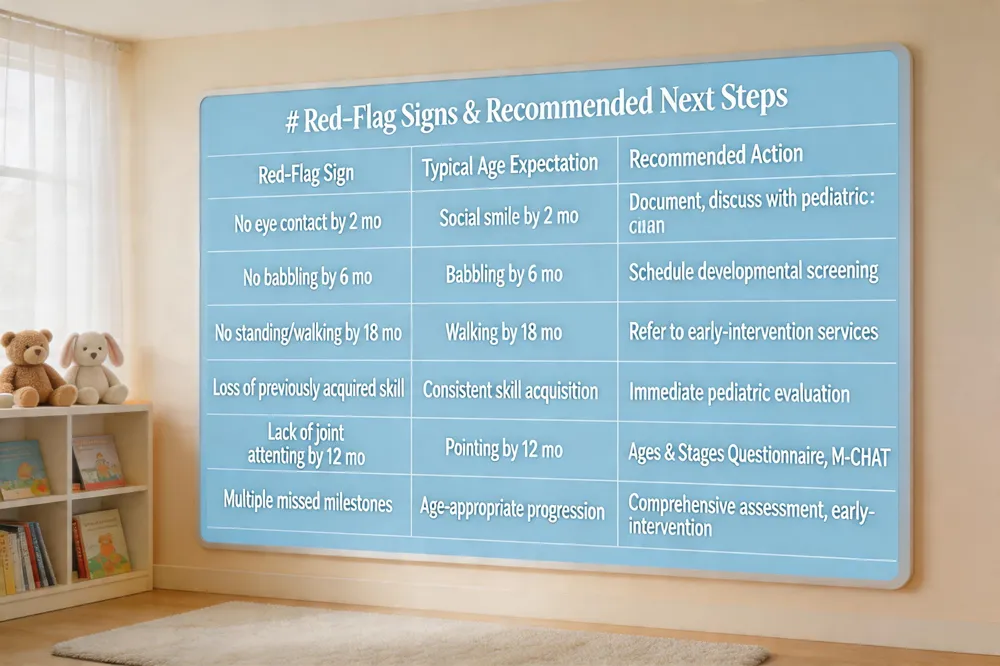
Red‑Flag Signs & Recommended Next Steps
| Red‑Flag Sign | Typical Age Expectation | Recommended Action |
|---|---|---|
| No eye contact by 2 mo | Social smile by 2 mo | Document, discuss with pediatrician |
| No babbling by 6 mo | Babbling by 6 mo | Schedule developmental screening |
| No standing/walking by 18 mo | Walking by 18 mo | Refer to early‑intervention services |
| Loss of previously acquired skill (e.g., using words) | Consistent skill acquisition | Immediate evaluation by pediatrician, possible referral to speech/OT |
| Lack of joint attention/pointing by 12 mo | Pointing by 12 mo | Complete Ages & Stages Questionnaire, consider autism screening (M‑CHAT) |
| Multiple missed milestones across domains | Age‑appropriate progression | Arrange comprehensive developmental assessment, initiate early‑intervention referral |
 Identifying red‑flag signs
Red‑flag signs appear when a child fails to meet multiple expected skills, loses a previously acquired ability, or shows concerning behaviors such as lack of eye contact, no babbling by six months, or inability to walk by 18 months. The CDC’s “Learn the Signs. Act Early” checklists flag these delays, and the American Academy of Pediatrics recommends formal screening at 9, 18, and 30 months to catch them early.
Early‑intervention referrals
If a red‑flag is noted, parents should document the missing or regressed skill and the last time it was observed, then promptly schedule an appointment with their pediatrician. At Kids & Teens Primary Healthcare in Decatur, Georgia clinicians use standardized tools (e.g., Ages & Stages Questionnaire, M‑CHAT) to confirm concerns and, when needed, refer families to state early‑intervention programs. Early referral to specialists—speech‑language pathologists, occupational therapists, or developmental pediatricians—has been shown to improve long‑term outcomes and can provide services at no cost to families.
Support offered by Kids & Teens Primary Healthcare
The practice supplies printable CDC checklists, the Milestone Tracker app, and activity ideas to encourage skill development while an evaluation is pending. Providers also discuss nutrition, sleep, and parent‑child interaction strategies that reinforce growth across motor, language, social‑emotional, and cognitive domains. By acting quickly, families help ensure their child receives the support needed to thrive.
Putting It All Together
Regular well‑child visits are the foundation for early detection of developmental delays, allowing pediatricians to intervene promptly. Using CDC’s Learn the Signs. Act Early checklists and the AAP’s screening schedule, providers systematically assess motor, language, social‑emotional, and cognitive milestones. By engaging families with printable checklists, the Milestone Tracker app, and multilingual resources, parents can monitor growth at home and flag concerns early. Prompt communication with a trusted clinician ensures timely referrals, supporting each child’s optimal health and future success.